
Custom & Replacement Mechanical Seals
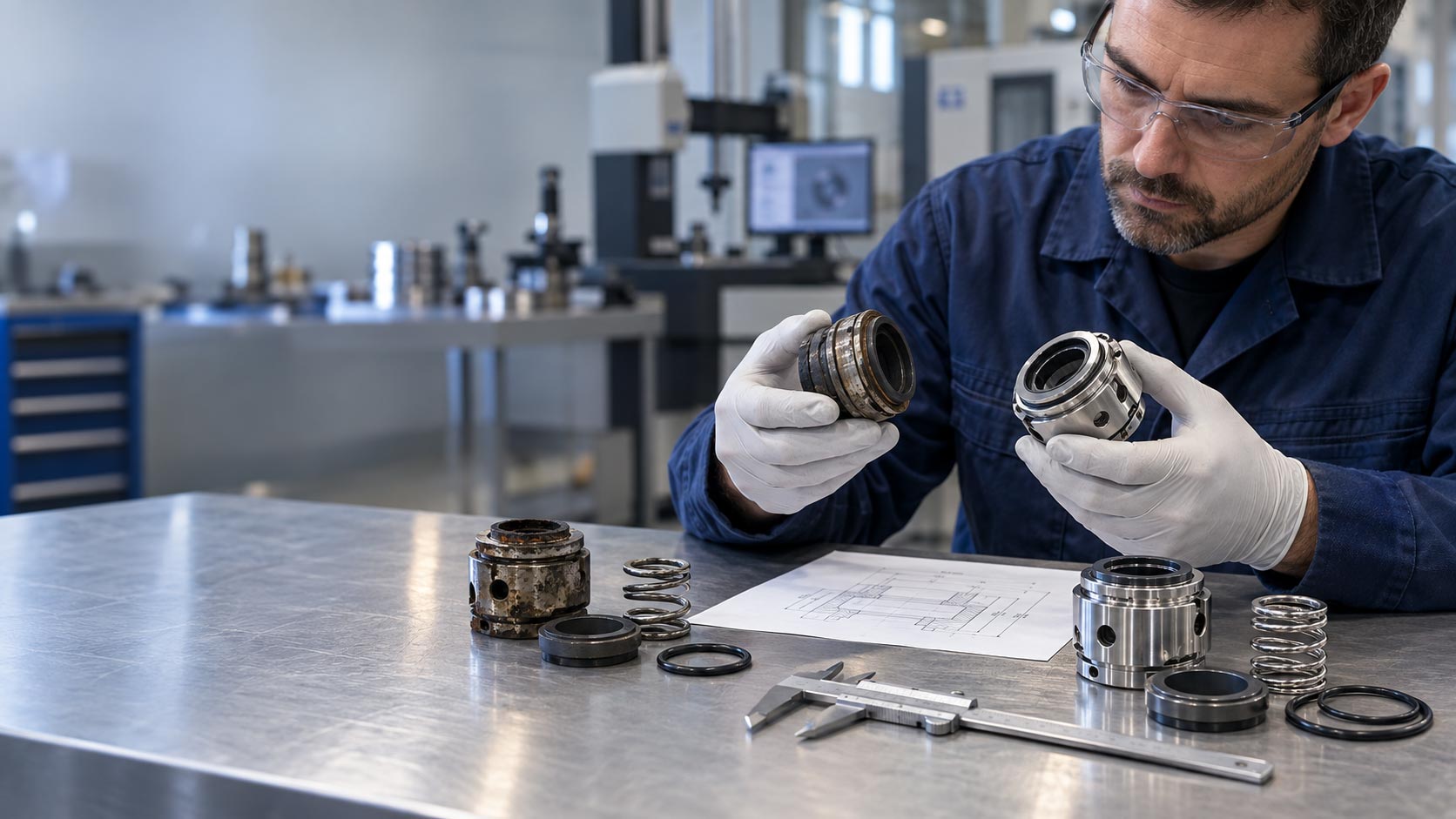
Send your old seal, drawing, dimensions or clear photographs — we will review the design and recommend a compatible replacement for your equipment and operating duty.
Need a replacement for a mechanical seal that is imported, discontinued, damaged or unavailable from the original equipment supplier? Ashish Seals India manufactures custom and replacement mechanical seals for pumps, agitators, mixers, reactors and other rotating equipment.
We can work from an old seal sample, dimensional drawing, equipment details, part number or photographs. However, a matching size alone is not enough. The replacement must also suit the process medium, pressure, temperature, shaft speed and equipment condition.
When Do You Need a Custom or Replacement Mechanical Seal?
A standard seal may not be suitable when the machine has an unusual shaft size, restricted installation space, non-standard seal chamber, special material requirement or repeated seal failure. A custom or replacement seal is commonly required when:
| Buyer Requirement | Our Approach |
|---|---|
| Replace an imported seal | Review the sample, dimensions, materials and operating conditions before confirming an equivalent design |
| Replace a discontinued seal | Develop a replacement from the existing seal, drawing, photographs or equipment details |
| Match a non-standard size | Measure critical dimensions and confirm the installation arrangement |
| Improve a repeatedly failing seal | Review failure pattern, fluid, temperature, pressure, vibration and installation condition |
| Seal an unusual pump or vessel | Develop a design around shaft, chamber, gland and operating limitations |
| Change process medium | Reconfirm face, elastomer and metal compatibility for the new duty |
| Reduce installation-setting errors | Review whether a cartridge arrangement is suitable |
| Replace a seal from incomplete information | Request the most useful available data, then confirm before manufacturing |
Mechanical Seals We Can Customise or Replace
| Seal Category | Typical Equipment |
|---|---|
| Pump mechanical seals | Centrifugal, chemical, slurry, water, hot-oil and process pumps |
| Agitator mechanical seals | Mixing tanks, vessels and top-, bottom- or side-entry agitators |
| Reactor mechanical seals | Chemical, pharmaceutical and process reactors |
| Cartridge mechanical seals | Pumps, mixers, agitators and reactors requiring pre-set installation |
| Spring mechanical seals | General industrial and centrifugal pump duties |
| Rubber bellow mechanical seals | Water and general process applications |
| PTFE / Teflon bellow mechanical seals | Corrosive chemical applications |
| Metal bellow mechanical seals | High-temperature and hot-oil services |
What to Send for a Fast, Accurate Replacement Review
The more information you provide, the more accurately we can recommend a replacement seal.
| Information to Share | Why We Need It |
|---|---|
| Old seal sample | Helps verify dimensions, construction and wear pattern |
| Drawing or datasheet | Confirms critical installation dimensions |
| Clear photographs | Useful when a sample cannot be sent immediately |
| Equipment make and model | Helps identify the equipment arrangement |
| Shaft or sleeve diameter | Confirms the basic seal size |
| Seal chamber or stuffing-box dimensions | Confirms fitment and gland requirements |
| Process medium | Determines compatible materials |
| Pressure and temperature | Determines seal arrangement and material suitability |
| Shaft speed and direction | Important for design selection |
| Existing seal failure details | Helps avoid repeating the same failure |
| Required quantity | Enables the correct quotation and production planning |
Our Replacement-Seal Review Process
Identify the Existing Seal — we examine the old seal, drawing, photographs or available dimensions to understand the original arrangement, face configuration, secondary seals, spring or bellow design and gland connection.
Check the Actual Operating Duty — we review the equipment type, medium, concentration, pressure, temperature, speed, solids, vacuum conditions and any history of dry running, vibration or shaft runout.
Confirm Materials and Construction — face materials, elastomers, bellows and metal components are selected according to the actual duty from carbon, ceramic, silicon carbide, tungsten carbide, NBR, EPDM, FKM, FFKM, PTFE and suitable metal options.
Manufacture and Verify the Replacement — after the technical review, the replacement design is manufactured to the confirmed requirements. Critical dimensions and assembly requirements are checked before dispatch.
Do Not Replace a Seal Only by Appearance
Looks Similar Is Not the Same as Performs the Same
Two seals can look similar but perform very differently. A replacement that fits physically may still fail if it uses the wrong face materials, elastomer, spring arrangement or balance ratio.
Common reasons a replacement seal fails prematurely include:
If your seal keeps failing, send the failed unit with the operating details. We can review the cause before reproducing or changing the design.
Why Choose Ashish Seals for Custom and Replacement Seals?
Custom and replacement designs — for industrial rotating equipment of every type.
Support from samples, drawings, photographs and dimensions — whatever reference you have, we can start from it.
Replacement options for imported and discontinued seals — reviewed and confirmed before manufacturing.
Mechanical seals for pumps, agitators, mixers and reactors — a single technical enquiry process across equipment types.
Application review before recommending a replacement — matching size alone is never treated as sufficient.
Standard and non-standard requirements handled together — from the same technical enquiry process.
Frequently Asked Questions
Can you make a mechanical seal from an old sample?
Yes. An old sample is one of the best ways to confirm dimensions and construction. Please also share equipment and operating details so the replacement suits the actual duty.
Can you replace an imported mechanical seal?
Yes. We can review an imported seal sample, drawing, part number or photographs and develop a suitable replacement after technical confirmation.
Can you replace a discontinued mechanical seal?
Yes. We manufacture replacements for obsolete and unavailable seals from a sample, drawing, dimensions or equipment details.
What if I do not have a drawing?
Send clear photographs of the seal from multiple angles, along with shaft size, equipment details and all visible dimensions. An old sample is preferable where available.
Can you make a seal for a non-standard pump?
Yes. Custom mechanical seals can be developed for non-standard shafts, chambers, gland dimensions and equipment configurations.
Can you modify a seal to stop repeated failure?
Possibly. The cause of the repeated failure must be reviewed first. Simply repeating the old design may not solve dry running, incompatible materials, vibration or operating-condition issues.
How long does it take to receive a custom mechanical seal?
Lead time depends on the design, materials, dimensions, quantity and production requirement. Send the enquiry details for a practical quotation and delivery confirmation.
Which materials are used in replacement mechanical seals?
Common face materials include carbon, ceramic, silicon carbide and tungsten carbide. Secondary-seal and metal materials are selected according to the fluid, temperature and service conditions.
Can you replace a pump mechanical seal?
Yes. We handle replacement pump seals for centrifugal, chemical, water, slurry, hot-oil and other industrial pumps.
Can you replace agitator and reactor seals?
Yes. Send the vessel or reactor drawing, shaft-entry arrangement, process conditions and old seal details for review.
Is shaft diameter enough to order a replacement seal?
No. Shaft size is important, but chamber dimensions, operating conditions, materials and seal arrangement must also be checked.
Can a damaged mechanical seal be repaired instead of replaced?
Some seals may be repairable after inspection. We can advise whether repair, refurbishment or a new replacement design is more suitable.
Do you supply custom mechanical seals across India?
Yes. Share the technical requirement, sample or drawing and delivery location to receive a quotation.
Request a Custom or Replacement Mechanical Seal
Send your old mechanical seal, drawing, photographs or equipment details to Ashish Seals India. Include the process medium, pressure, temperature, shaft size, speed and reason for replacement so we can recommend the correct custom or replacement design.